Monday, September 23, 2013

Monday!

I will quickly post the French reading homework and hopefully follow up with more later tonight.  Students should always practise reading in French at home to reinforce the sound combinations we are learning in class.


 It was a busy day in Art class - we really have to stay focused and on task if we want to accomplish anything in our 40 minute art period, (share lesson goal and techniques, distribute supplies, get down to business, clean -up and return to homeroom classes - wow I am just pooped thinking about all we did today).  Of course, we have no finish products to display yet, but we are well on our way to mixing colours, creating tints, creating an optical allusion of movement with our waving lines AND writing poetry  ALL in one project!


Continuing with the art/poetry theme, in English we are writing I AM poems and partial self-portraits - hopefully ready to share with you by our Meet the Teacher Night.  Both lessons taken from Runde's Room, one of my favourite blogs.

En français, we have begun studying the verb to be, être.  We have also began a new little reader, focusing on the the sound é, es, ai, er, ez, ée.

Don't forget that we have our first little quiz in Social Studies tomorrow.  See the class calender for details.

In math, my group has begun working with decimal numbers to the hundredths.  We will focus on reading, presenting, ordering and comparing decimal numbers to the hundredths for the rest of the week.

Note:  I have moved the sign up for email notification to the top of our blog page.  Please sign up to keep current of our adventures in room 205.

Friday, September 20, 2013

Yay for Friday!

We've worked hard all week and now we deserved a break!

Our day:


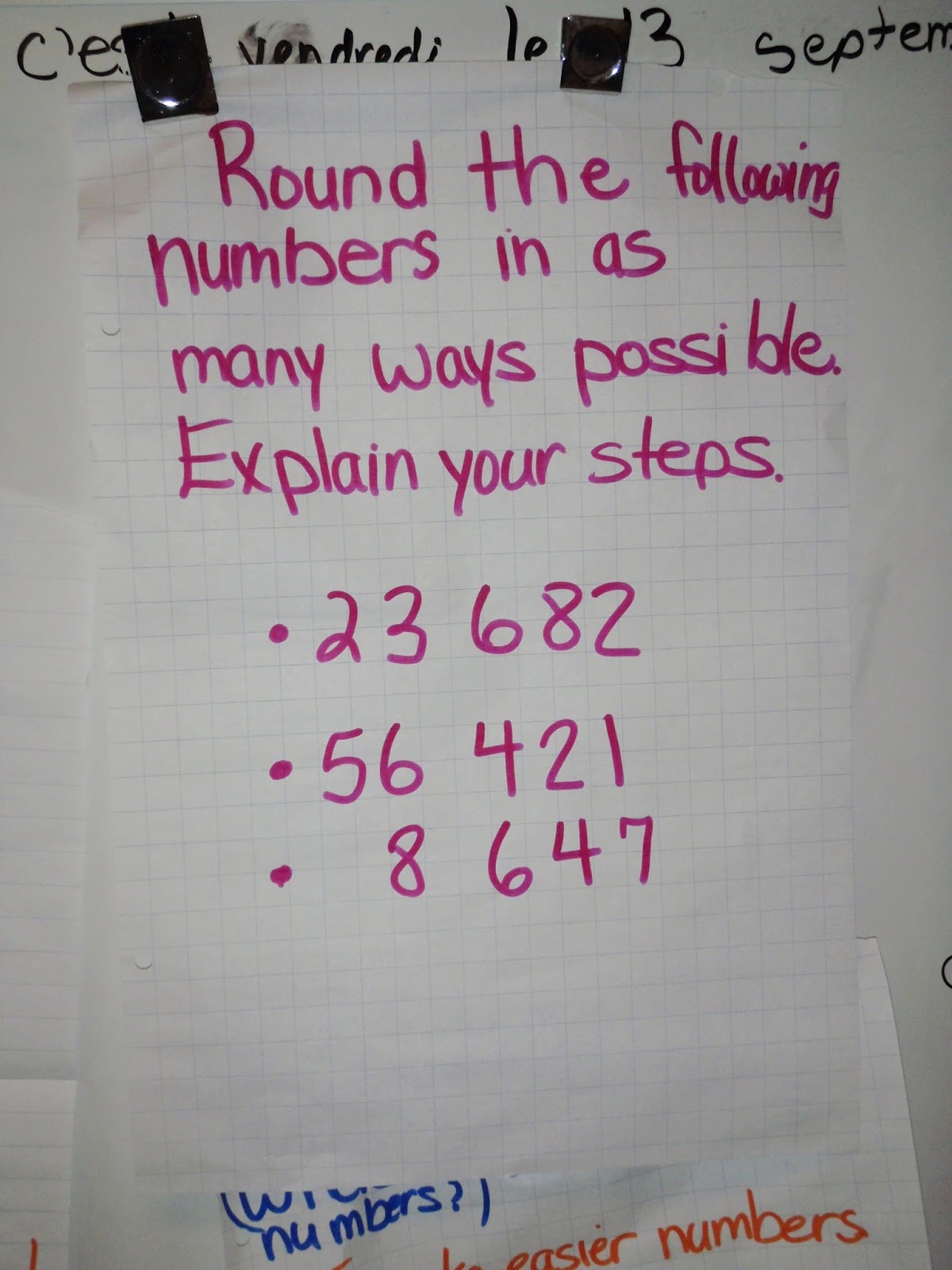
The math problem that stumped the class.  We began with a Minds-On that had us rounding numbers in different ways, then made our way to the Rounding Problem.  After working on the problem for a bit, students took a break and shared some strategies, then attacked the problem again.  Some groups looked like they were on their way to completely solving the problem, but ran out of time before they could fully communicate their reasoning and check their answer for reasonableness.

Using the following success criteria, students ploughed through this challenging problem.


As you can see, every group was able to show some understanding of the task.  Some needed a little teacher support to boost their confidence and guide them through some of the shared strategies.


This group, instead of using the rounding rules to help them find the solution, used a less reliable strategy for this problem, guess and check.  Luckily, they did guess (or overhear the group next to them), the least number that would round to all three given numbers.  When checking their guesses, they did use rounding rules.  (seen on their planning sheet, not yet transmitted to their chart paper)

This group attempted to use the number line strategy to find a solution.


This group found a number that does meet the criteria.  However they were not able to give a range of numbers to come to a final solution.  They showed an ability to round to the closest 100s, 1 000s and 10 000s.

This group lost their confidence and decided they wanted to practise rounding over the weekend.  However, when I sat with them and had them walk me through the steps for rounding, they were able to do it.  It was the problem that intimidated them.

They found a range of numbers that met the criteria, but needed to go a little further to include all the possibilities.

Found the solution.   They were on their way to proving it and communicating their findings when we stopped to share our work.  As a group, we followed through with checking for reasonableness and proved this solution to be accurate.  


 They were able to find the greatest possible number, but did not quite go low enough to find the lowest number.

With some prompting and guidance, this group showed me that they could  round.  We found the solution together, but had not fully explained our reasoning.
If you are looking for a Number Sense Problem challenge try the Problem of the Week at the following link: Problem of the Week.

In French, students begin each day by  practising a scripted conversation with a partner.  They are working towards their first oral presentation in French, at the end of the month.  We took up our AVOIR work from yesterday and competed in Verbarama.  Congratulations to students who were not only able to completely conjugate the verb, but did so in order!  We finished reading and responding to our first book (5 stories) and are ready to move on to the next level.  Some students may even be able to move beyond the next level!  Finally, as suggested by Mlle Dunne, we watched a short French television show, listening for key words (and any other word we recognized) while paying attention to main ideas and main characters. I think students surprised themselves by how much they understood.


Just a reminder that our first little quiz in sciences sociales is this coming Tuesday.  As previously mentioned, we are focusing globe and mapping skills, as well as learning the continents and oceans in French. Students should be able to label a map, with correct spelling, in French.


In English, we continue to focus on thinking beyond what is written, using a variety of reading strategies.  Our primary focus, at this time, is making connections.


I hope everyone has a relaxing weekend!  Remember to check out the attached math links on the right-hand side of the blog for extra math fun and support.

Thursday, September 19, 2013

AUTHOR VISIT!

Author Michael Wade (And then it Happened series) visited Admiral today.  Not only did he keep us completely enthralled and entertained, he certainly convinced us  that any average person can be a writer! This special man, began writing 11 years ago, when he was a 40 year old prison guard.  He averages about 7 rewrites of every book he publishes.  Although full of grammar and spelling mistakes, his drafts through revision and fine editing make it to publication and can be found on the shelves of every elementary school library across Canada!  He is a true inspiration for students and teachers.  At the end of his performance, Dominic in Grade 6 won a signed copy of a book of his choice, and Mackenzie, from my homeroom class, was also given the choice of a signed book for her birthday! (P.S. A big thank you to Mackenzie's grandmother for the peanut-free birthday treats! Yummy cupcakes!).

Unfortunately, I dropped the camera and I cannot access the photos from today...sorry.


Tuesday, September 17, 2013

We Have Been Busy Little Bees!


Sciences socials - en français!

We are focusing on mapping skills and language acquisition in Social Studies.  Beginning with the familiar, while we build our second language knowledge, will help us also build confidence.  Students are reviewing the provinces and territories of Canada, but in French!  They are also becoming familiar with the globe in French, learning the oceans and continents as well as other map and globe skills. 


Math


 In Math we have continued to focus on Number Sense.  The above journal helped me see your child's understanding of the given quantity and his or her comfort with four or five digit numbers.  Many students felt more comfortable with 4-digit numbers.  My goal is to move them into the 5-digit comfort zone.  Real life applications for these numbers was a little tricky, but lead to some pretty interesting math journal stories!

Two of our open ended questions pertaining to Comparing and Ordering Whole Numbers to 100 000, and Representing and Renaming Whole Numbers to 100 000 came from Edugains Gap Closing resources.  Click here to access the site. (Modules 4 and 5).


 This past week, we have been focusing on reading and representing numbers in a variety of ways.


 Understanding place value gives us a greater understanding of numbers and the value of their individual digits. We have been using the place value chart to help us read, write and round numbers.


This next math journal helped me see how students understood comparing and ordering numbers.  In my rush to give students timely feedback, I returned the math journals to them without scanning any samples.  Perhaps I can scan a few today.


 Below, you can see students using number lines and benchmarks to help them round numbers in a variety of ways.  I love how well they worked in groups.  Some used the place value chart and the rounding rules to help them.  We have a few rhymes to help us remember the steps for rounding.  For example:


Circle your number


Look next door

5 or greater

Add one more


Numbers to the left 

Stay the same

Numbers to the right

Zero's your name!

OR


Find the number

Look next door
4 or less, just ignore
Greater than 5, add one more


I am especially pleased that some groups included a written explanation to accompany their work, and some groups rounded using more than one method!


With partners, students showed a pretty good understanding of rounding, but to ensure that each student had fully grasped the concept, they had to complete an Exit Ticket on their own before leaving.  This showed me that several students still needed to reinforce the concept.  But at least half the class has completely mastered this skill!  The next day, Mr. Bristow continued working with rounding until almost all students could meet success with rounding 5-digit numbers.


Based on the Exit tickets, I was able to pull a small group for guided math to reinforce the concept of rounding while the rest of the class worked on a Number Sense activity with a partner.  One student was eager to show her work (seen below).  All students showed success and graduated to the addition game.


Using math manipulatives to solve the problem!
 Tomorrow, students will be reading for a Rounding Problem!!!! Yay! It is quite challenging, so stay tuned for updates.

Français

En français, we continue to study le verbe avoir. Ask your child to sing you the Avoir rap!


We have begun our French journals with a scripted journal by filling in the blanks with familiar and practiced vocabulary.  But, yesterday, with a Journal Helper, students wrote independent journals.   They seemed pretty proud to communicate their ideas in French on their own!


Language Arts

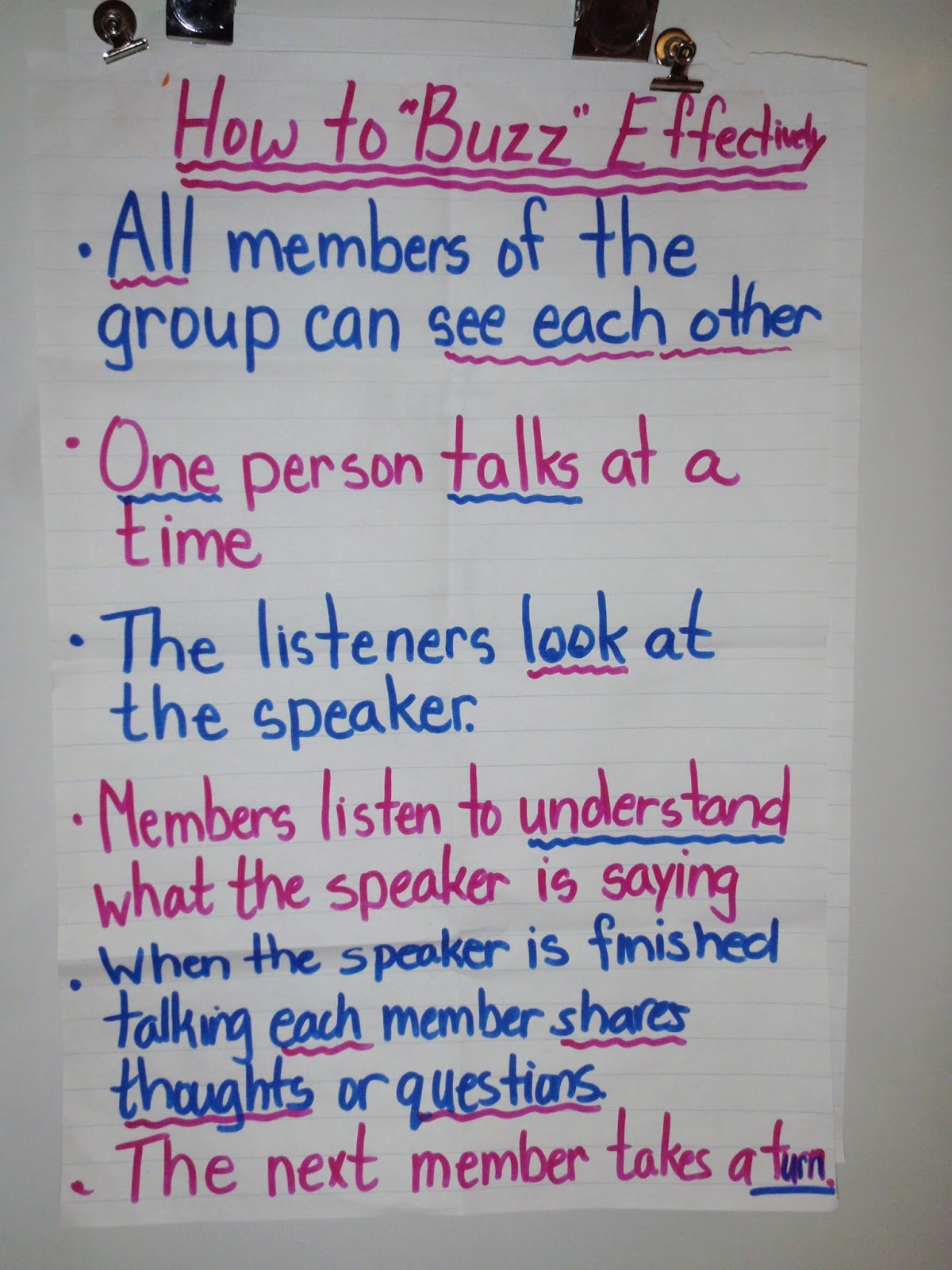
In English, we have continued to focus on the First 20 Days of Reading.  On Friday we practiced Buzzing effectively.  First we began with a jigsaw.  Students from home groups were divided into expert groups.  Each member had to become an expert on their given topic, then report back to their home groups.  This taught students to take jot notes of main ideas and important supportive details, discuss their findings with their group ,and  respect group etiquette.  Each student had to take ownership for their learning and responsibility for the teaching of others.  Most handled this task extremely well.  Included are the five texts (taken from This Child, Every Child) that we studied that afternoon.


In reading, we have also been concentrating on making connections.  We know as readers, we are constantly thinking beyond what is written to deepen our understanding of text.  One of the reading strategies that we use is making a variety of connections (as seen below).


Our current goal:


We began by writing a group connection.  Students provided the ideas for me to write a connection using a graphic organizer that will help me meet the established success criteria.

We connected the text Wonder, from our read aloud to a picture book entitled The OK Book.


Mr. Bristow then read The Dot.  In groups, students were asked to make a text-to-text connection between The Ok Book and The Dot. I just love how well most groups worked together without reminders and encouragement from the teacher. Once the groups completed their connections, they switched connections with another group.  Their next task was to write feedback for each other.  The group had to come up with a Star (something they liked about the work) and an Arrow ( a next step to improve the work) based on the established success criteria.  This proved challenging for some.


One of our strongest connections!
o
This group had a difficult time coming to a consensus, but with prompting they wrote a complex connection. As a next step, we would like them indicate how they can apply what they have learned from the connection or explain why this connection is important to us.  I really like how they finally pulled all their ideas together into a well developed connection.


Some of the groups were bang on with their connections! Others will use their feedback to improve their connection.  The next phase in the gradual release of responsibility will be to write individual connections to submit to peer and teacher feedback.

Thank you to Mackenzie for providing a wonderful fruity tea for Tea Time today.  Thank you to our servers and washers today. ( Each student has a weekly job assignment.)